Friesach, Austria 1947: Wartime Diary & A Lost Watercolour

Updated: Mar 23
Inherited Images: A Daughter's Journey Through Art and War - Central to the book are my father's RAF Wartime Diaries and Watercolours
I am taking this opportunity to share more about my forthcoming book because, after much deliberation and asking some of my readers for advice, I think I have at last come up with a good title: Inherited Images: A Daughter's Journey Through Art and War, one that I hope publishers will like.

It was difficult to pick a title that encompasses the book's many themes. I cover five generations of artists in my family, including many of their artworks, as well as my father's RAF diaries and watercolours from the Second World War. I already had a great deal of material to work through. I had resigned myself to the fact that there would be some truths I would never be able to discover. But my research took an unexpected turn when I found a plain green binder among my uncle John's belongings, and new pathways into our family's creative inheritance opened up.
John, my father's identical twin, never published his autobiography, but I will forever be grateful to him for writing down his thoughts and feelings. John's vivid recollections of their childhood, their years at Epsom Art School under Royal Academician and war artist Stanley Spencer, and the grief that followed their older brother's death at sea in 1942 were all subjects that I thought I would never be able to discover any meaningful, heartfelt facts about. My father could not bring himself to write about his older brother's death.

But at the centre of the book is my father, the dozen Second World War diaries, and the accompanying watercolours he gave me just months before his death.

But, as a former curator, I am most excited to uncover the stories behind paintings.
Before I tell you more about the lost Friesach Watercolour, If You're Interested In:
The Second World War
RAF history in the UK and Austria
Family memoir
Art of the Second World War
The Neo-Romantics
Then my new book may speak to you.
If you want to know how Inherited Images is progressing, you may want to subscribe to my blog. I only write a few blogs a year because my main focus is on finishing my book.
You can sign up for updates here: Amelia's Blog | Author Amelia Marriette
Watercolour' Friesach, the 16th of August 1947 - 'A Wartime Artist Finds Peace
My father was stationed at RAF Klagenfurt, in the British-occupied zone of post-war Austria. In 1947, he was twenty-three, nearing demobilisation, and longing for civilian life and to be reunited with his fiancée. As I relocated to Austria from the UK some years ago and now live in Carinthia, very close to where my father was stationed, I decided to celebrate what would have been my father's 100th birthday by visiting the sites of the paintings he completed while serving at RAF Klagenfurt.
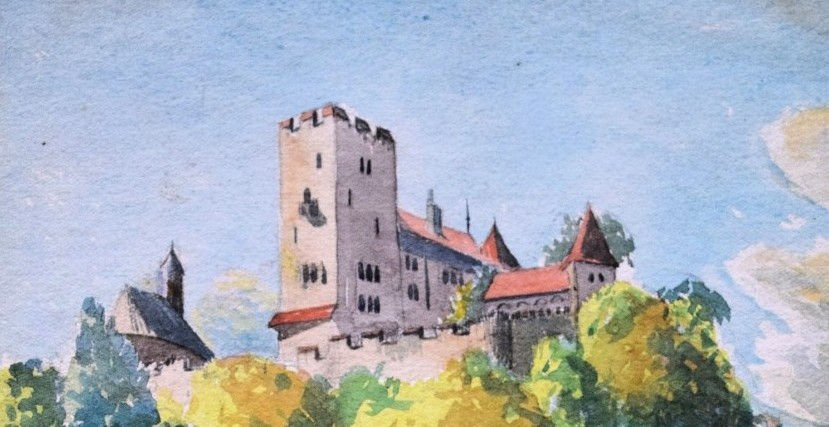
The painting I find most compelling and the one I return to again and again is a watercolour of Geyersberg Castle. At this point in his artistic journey, he was increasingly painting works of great beauty, and this is one of his finest Neo-Romantic watercolours. The subject lends itself to this because Friesach is one of Austria's oldest towns it still feels like a place out of time and is breathtakingly beautiful.
This particular painting was not with the others, which were safely stored in an old 1950s cardboard suitcase, but buried in a drawer in my father's studio. When I found it, I hoped I could match it to a diary entry. Luckily, as was his custom, my father had written the date on the back of the watercolour, and the diary entry is detailed and atmospheric. He captures the day perfectly, the longing he felt, his fears for the future, and his trip to a magical Austrian town.

Here is the Entry From My Father's Wartime Diary for the 16th of August 1947 in Friesach:
"Of the past days, there is little worthy of record. The days have passed, bringing the one thing I long for steadily nearer… I long for civilian life but hardly consider what it holds for me in these turbulent times. Certainly, financially, I shall be very much worse off."
My father, always keen to talk about the weather, noted that the 16th of August 'dawned warm and cloudless.' After a long night duty, he gathered his paints, paper, and a few cakes from the NAAFI and set out from camp. A passing army captain offered him a lift, and they hurtled through the Austrian countryside to Friesach, a medieval town he had glimpsed only briefly before.
What he found there captivated him:
"Quite the prettiest I have seen in Austria… The houses clustered together with bright red rooves… two magnificent churches… picturesque old ruined castles… clear static water with fantastically vivid emerald green aquatic growth."
He wandered the marketplace, climbed to a high point overlooking the valley, and then selected a spot to sit and paint. For several hours, he worked in the heat of the afternoon, surrounded by swallows, martins, flycatchers, yellow wagtails, and siskins, birds that reminded him of his childhood home in leafy Banstead, Surrey.
"I could not help but feel at peace with myself, at least in such an agreeable spot."
The resulting watercolour, which he entitled 'Friesach, the 16th of August 1947', is one of his best works from this period of his life.
How Did My Father Create The Lost Watercolour Called 'Friesach, the 16th of August 1947'?
Artists, historians, and collectors often ask which colours were used in a typical British watercolour field set during the 1940s. By researching period catalogues and pigment history, I've reconstructed the most probable 12‑pan palette used by soldiers, war artists, and field sketchers during the Second World War. While one can never say with absolute certainty, because artists have their own unique tastes, my father's set of watercolours would have been small and limited; he had to travel with it from Britain, and, allowing for wartime restrictions, these are the most likely 12 pigments:
Prussian Blue
Indigo
Ultramarine
Emerald Green
Sap Green
Yellow Ochre
Burnt Sienna
Raw Sienna
Vermilion
Crimson Lake
Ivory Black
Chinese White

Most Probable 12 Watercolour Pigments used in Field Sets in the 1940s
To create the watercolour, he would almost certainly have begun by laying down a wash, making it slightly wetter than usual because the paper would have dried quickly in the hot sun. Working outdoors in August meant he had to move fast, mixing his colours on the lid of his watercolour box, which doubled as a palette. But a detailed work like this would have required him to keep his brush relatively dry too; a difficult balancing act.
With these few colours, he had to mix carefully and intuitively. Ultramarine softened with a touch of Chinese White would have allowed him to match the pale, heat-hazed sky.
Yellow Ochre mixed with a little Emerald Green could have created the deep, bronzed green of the beech trees, which were planted in a long, straight line and glowing in their high‑summer foliage.
He managed to capture the light of the afternoon sun, creating a corridor of green-leafed beech trees exactly as he imagined them. For the terracotta roofs of the farm buildings, he would most likely have used Crimson Lake and Burnt Sienna, and he knew that if he used too much crimson, he would risk tipping the whole composition into something gaudy or childlike.
He even transformed the road in the foreground: instead of a dull grey, he rendered it as a purple‑blue ribbon, making the man‑made element more harmonious within the landscape.
The result is a jewel-like work that aligns with the ideas of the Neo-Romantic artists of the 1940s.
The painting captures the importance of 'place' – something my father shared with his most admired Neo-Romantics, Paul Nash, John Piper and Eric Ravilious. The ancient square-turreted castle, surrounded by lush scenery, seems to be set in a magical space, one that had survived the war unscathed – this would have appealed to my father, as he had seen so much devastation as he travelled to Austria.
It is not only the importance of place that he conveys, but also the idea that art can provide solace. He managed to create a moment of calm in his own life at a time when he was troubled, unsure, and uncertain. But more than that, he also created a slice of beauty for posterity. Remarkably, this blog post marks the first time the painting has been seen publicly for 79 years.
Who is Inherited Images for? For All Artists Who Persevere in Wartime
Inherited Images is dedicated to my family and to all creative families who endured and preserved their creative talents during the darkest years of the 20th century. For artists, the opposite of war is not peace, which is passive, but creation and making, which is active. Artistic endeavour stands as a testament to the fact that beauty, humanity and resilience can still exist even in the midst of devastation. The making of art is not only an act of expression but also a profound statement of hope and renewal. A truth as vital now as it was then.
What does Inherited Images Reveal? 17 Wartime Diaries and Twenty-Four Wartime Watercolours
Inherited Images places my father within the long arc of his artistic family, tracing his journey from RAF training camps across Britain to Egypt, Algeria, and finally Austria. His diaries and twenty-four wartime paintings form the heart of the narrative, but the book is also about what endures, creativity, memory, and the resilience that carries families through turbulent times
As I continue uncovering his story, I hope this look at Friesach, Austria, 1947, a wartime diary, a watercolour, and the traces of my father's RAF years, inspires you to explore the treasures within your own family.
A Final Invitation - Last Signed Full‑Colour Copies of Walking into Alchemy: The Transformative Power of Nature
I have a very small number of signed, full‑colour publisher copies of my nature memoir, Walking into Alchemy: The Transformative Power of Nature (Mereo Books, 2019). These are the final copies printed in full colour — once they're gone, they're gone!
You can order directly from me for 15 Euros with free P&P in the UK and Europe:
Walking into Alchemy includes a chapter about my father at RAF Klagenfurt, and the book marks the beginning of the journey that led me to write Inherited Images.
I hope you will follow the journey of Inherited Images as it unfolds.
And if you would like to grab one of the last signed full‑colour copies of Walking into Alchemy, you can order here:
Further Exploring:
More about RAF Klagenfurt
More About Friesach
If you’d like to learn more about the Neo‑Romantic movement that influenced artists like Paul Nash, John Piper and Eric Ravilious, the Tate offers an excellent overview: Neo‑Romanticism.


Thank you so much for your comment. All artists, especially those working under trying conditions or in times of conflict, should be remembered for their work and dedication.
Very moving- makes me feel proud and exceptionally grateful to Amelia for producing this amazing piece of work / the time and energy needed to create this work - is unbelievable and has enlightened the talent and quiet thoughtfulness of my much loved father ,
Thank you Amelia for doing this for us and posterity. Xx